Impact and Partnerize made opposite bets on how publishers get paid once AI answers replace the click. Nine months on, both bets depend on brand budgets, and on measurement that brands will trust.
In January, two weeks apart, two affiliate platforms gave publishers opposite answers to the same problem. Partnerize brought VantagePoint to publishers on January 14 (opens in a new tab). Impact launched Geodesix on January 28 (opens in a new tab). Nine months later the picture has moved, and the update says more than the launches did.
The problem hasn't changed
AI answers are absorbing the clicks that commerce content used to earn. Pew found that Google users who saw an AI summary clicked a traditional result on 8% of visits, compared with 15% when no summary appeared (Pew Research Center, July 2025). Similarweb now puts the share of Google searches that end without a click at 68% (opens in a new tab).
For a commerce publisher, the reader still reads the review. They just read it inside an answer, then go straight to the retailer. The influence is intact. The affiliate link that used to record it never gets clicked, so the publisher gets no credit and no commission.
Two bets, as launched
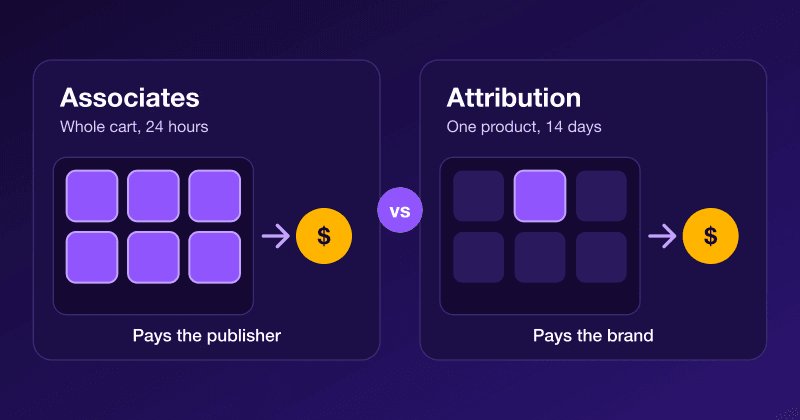
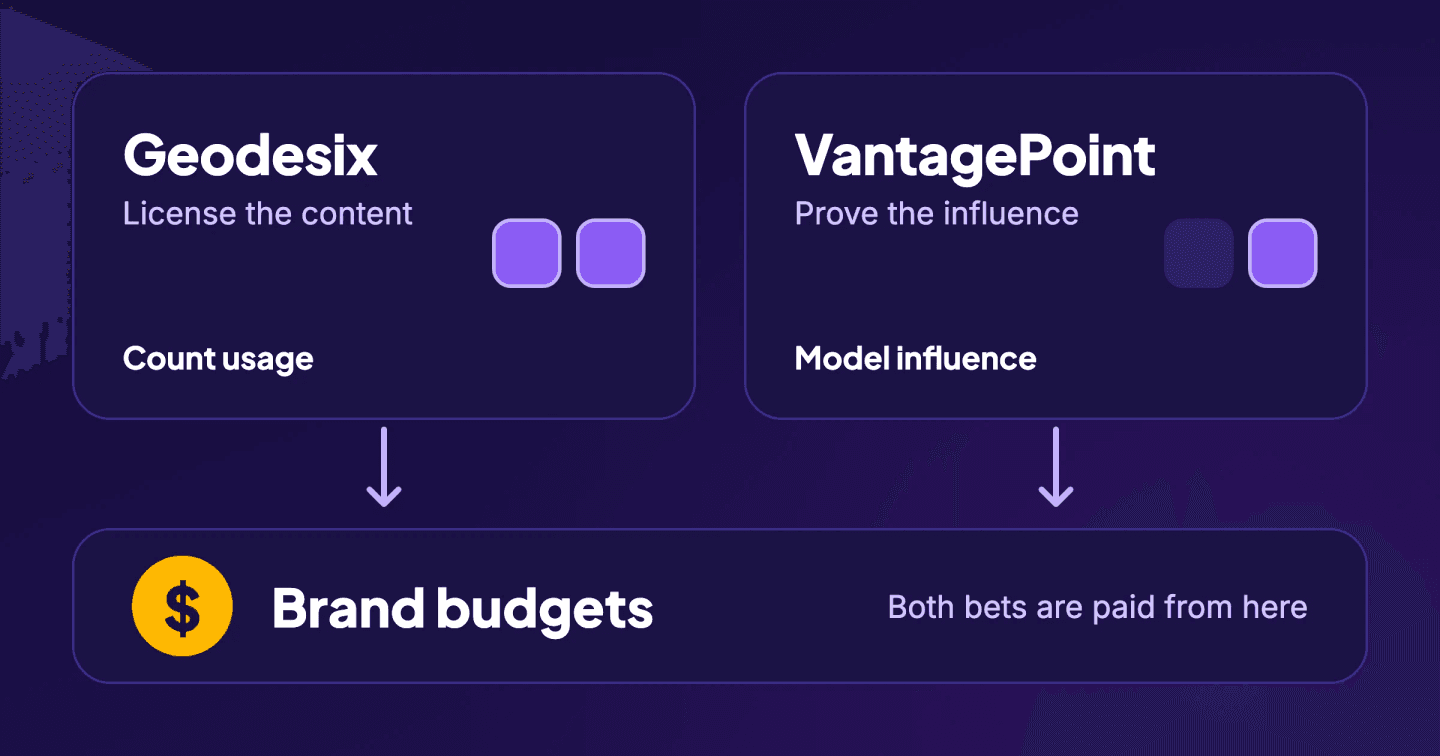
Geodesix: license the content. Geodesix came out of Impact Labs as a data marketplace connecting premium publishers with AI systems. AI companies would pay to use commerce content (reviews, buying guides, comparisons), and a "share-value" model would split that money according to how much each piece contributed to an answer. The buyer was the AI platform. Think streaming royalties.
VantagePoint: prove the influence. VantagePoint runs on Konnecto, which Partnerize bought in June 2025 (opens in a new tab). It uses clickstream-based journey reconstruction to connect a publisher's citations in AI answers to later purchases on brand sites. Its headline metric, HaloIndex, is the ratio of that AI-driven influence to the credit last-click attribution already gives. The buyer was the brand, paying commission on influence it couldn't see before.
One was a supply-chain fix, the other a measurement fix. They drew on different budgets, so in January the obvious conclusion was that publishers should take both: get paid by the AI platform for using the content and by the brand for the sale.
What happened next
Licensing got crowded. In February, Microsoft launched its own Publisher Content Marketplace (opens in a new tab), with Business Insider, Condé Nast, Hearst, the AP, USA TODAY and Vox Media supplying content and Copilot and Yahoo among the first buyers. When an AI platform runs its own marketplace, there's less room for an intermediary between it and publishers.
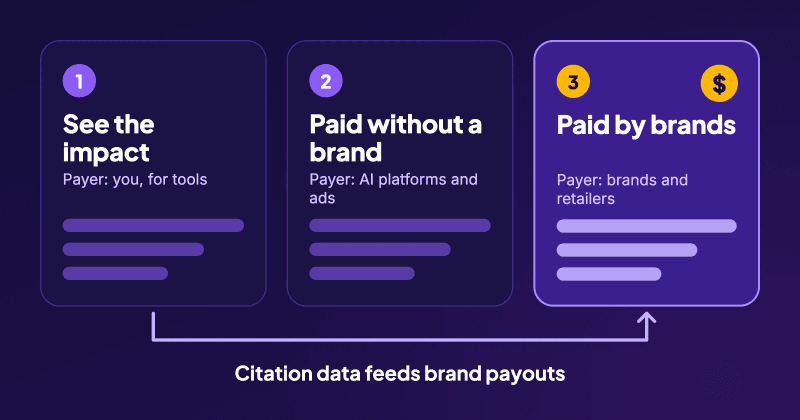
Geodesix changed its buyer. Its site (opens in a new tab) no longer leads with AI labs. It now pitches retailers: license quotes from publishers' reviews of your products, use them in ads, product pages, checkout and chatbots, and pay only when they're used. Retail media platforms can show those citations in shopping assistants and pass the cost to the brand. Publishers still get paid for their content, but the money now comes from brands.
VantagePoint started paying. In April, Partnerize launched its Influence Compensation Lighthouse Program (opens in a new tab), with Adobe, HubSpot, Profound, Away and Vox Media among the first participants. Payouts follow the VantagePoint Fractional Compensation Standard, which the Alliance for Audited Media has certified, and Ipsos is evaluating the program independently. Partnerize is underwriting payments during the pilot, and brands are meant to fund them after it. In July, Partnerize published data (opens in a new tab) claiming publishers drive 3.84 times more influence than affiliate programs credit them for, ranging from 1.54x in consumer audio to 10.94x in luxury fashion. Those are Partnerize's numbers, produced by Partnerize's own method, but they point the same way as the click data above.
The trade body caught up. The APMA's July white paper, produced with support from Impact, tells the industry (opens in a new tab) to reward AI citations and visibility, not just clicks. Its survey found that 34% of respondents can't measure traffic from AI platforms, and only 13% have turned AI visibility into revenue in their partnerships.
Shoppers still buy on the brand's site. In March, OpenAI scaled back Instant Checkout (opens in a new tab) and began sending shoppers to merchant sites and apps instead. For now, people find products in AI and buy them on the brand's own site. That leaves a purchase on the brand's site that journey reconstruction can still observe.
Both bets now depend on brand budgets
Put those together and the January split no longer holds. Geodesix sells a publisher's credibility to a retailer. VantagePoint sells a publisher's influence to a brand. Both are now funded from brand marketing budgets.
AI platforms do pay for content, but so far most of that money has gone to large publishers, through direct deals and platform-run marketplaces. For most commerce publishers, AI-era revenue will come from brands: commissions, fees and licensing paid by the companies that want the sale. Getting paid by both the AI platform and the brand looks less likely than it did in January.
The real contest is over measurement
Brands spend when their finance teams accept the measurement behind the spend. That makes measurement, not packaging, the deciding question.
Each model has a weak spot. Geodesix can count usage precisely (a quote was shown, a citation was clicked), but usage isn't the same as influence. VantagePoint gets closer to influence, but it models that influence from a clickstream sample, so it's only as good as the sample's coverage of a given category. Partnerize's AAM certification is a smart answer to that second problem. Even so, Adobe's Doug Wyatt told AdExchanger in April that measuring performance in AI search is still "all hypothesis." (opens in a new tab)
The ownership of the data matters too. Both systems are run by networks whose paying customers are brands. That doesn't make their numbers wrong. It does mean publishers shouldn't treat a metric built for brands as the only record of what their content is worth.
What I'd do as a publisher right now
- Know your own baseline. Track earnings by page, author, category, retailer and network, and watch which content is losing clicks but still converting. Without that, an influence score is someone else's number, and you have nothing to check it against.
- Ask how it's measured. For any influence or citation payment, ask what the sample covers, which categories it measures well, and how it avoids double-counting sales that last-click already credits.
- Bring influence data to rate negotiations. A credible HaloIndex or citation report gives you leverage for flat fees, hybrid rates and tenancy deals with brands you already work with. It supports those negotiations rather than replacing them.
- Write content that's easy to quote. Clear verdicts, current prices and honest comparisons are what AI answers and licensing products pull from.
- Make every remaining click earn more. Clicks are scarcer, but they haven't gone away. Revenue per visit matters more than it did a year ago.
Where we sit
Bullwhip works on the publisher side of all this. Beacon, our commerce analytics and attribution product, brings in data from Impact, Partnerize and the other major networks so publishers can see what every page earns. We want both of these bets to work, because publishers need every new source of revenue they can get. But whichever approach wins, publishers will need their own numbers to check it against.
Sources
- Pew Research Center, "Google users are less likely to click on links when an AI summary appears in the results," July 22, 2025.
- Affiverse, "Partnerize Expands VantagePoint to Publishers, Promises Payment for Zero-Click Influence," January 2026. VantagePoint first launched for advertisers on October 21, 2025.
- impact.com, "impact.com Launches Geodesix, a New Data Marketplace Connecting Premium Publishers With AI Systems," Business Wire, January 28, 2026.
- On Konnecto's use of clickstream data: Neudata vendor profile (opens in a new tab).
- Geodesix by impact.com, homepage, accessed September 15, 2026.