AI answers are built on publisher reviews but send back a sliver of the clicks. Here are the tools that measure that influence, pay for it, or help you sell it to brands, and what each is worth to a commerce publisher today.
The click is shrinking. The influence isn't.
AI answers now sit on top of the research layer commerce publishers own. Your reviews still shape the answer, but fewer readers click through to your page and your affiliate link. The open question is who pays for that influence.
The numbers that frame it:
- Google answers your queries first. AI Overviews appear on 95.4% of comparison queries and 85.9% of question queries, but only 5% of transactional ones (Seer Interactive, Apr 2026 (opens in a new tab)). That's the "best X" and "X vs Y" layer.
- Clicks fall when it does. Position-1 click-through drops 58% when an Overview appears (Ahrefs, Feb 2026 (opens in a new tab)). A randomized field study measured a 39.8% causal drop in outbound clicks (ISB/CMU via PPC Land, 2026 (opens in a new tab)).
- Publishers feel it. Google Search referrals across Chartbeat's network fell 40.2% year over year to July 2026 (Search Engine Journal (opens in a new tab)).
- AI doesn't send it back. AI apps drove 0.16% of external referrals to North American publishers in H1 2026 (TollBit via Digiday (opens in a new tab)). Only 6.8% of ChatGPT's US answers included an external link in May 2026 (Similarweb via SEJ (opens in a new tab)).
- What does arrive converts. AI-referred visits to US retail sites converted 54% better than other traffic in May 2026 (Adobe (opens in a new tab)).
- Your content is what the models cite. On 3,312 product prompts, RTINGS drew 16% of ChatGPT citations and PCMag, CNET, Tom's Guide and TechRadar 6–8% each (cloro, Sep 2026 (opens in a new tab)). Evertune finds over 40% of the top 10,000 AI-cited sources carry affiliate links or sponsored content (impact.com (opens in a new tab)).
The squeeze doesn't land evenly across publishers. The gap comes down to two things: whether you can prove your influence, and whether someone will pay for it.
The landscape at a glance
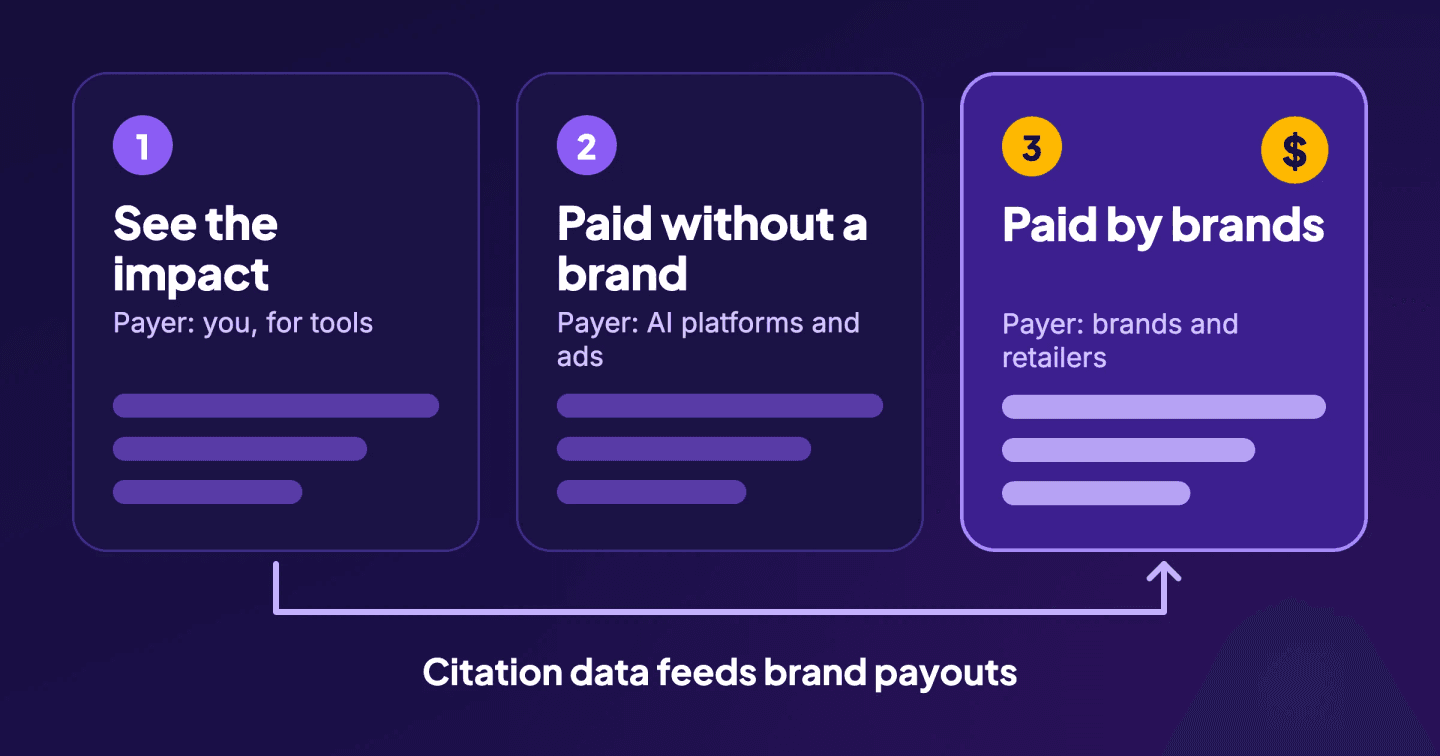
Every tool below is filed by the job it does for a publisher, not by how it markets itself:
- See it: measure where your content shows up in AI answers and what that's worth.
- Monetize indirectly: get paid for AI use of your content without a brand in the deal: licensing, pay-per-crawl, answer-engine revenue share, and affiliate revenue on AI-referred clicks.
- Monetize directly with brands: turn AI visibility into something a brand pays you for: affiliate-network GEO programs, citation-priced flat fees, sponsored placements.
Measurement on the left is starting to feed the brand deals on the right. The middle column mostly pays large news groups so far.
1. Which tools show your content's impact in AI answers?
Start with the free reports from Google, Microsoft and your CDN. Pay for citation tracking only when you plan to take the evidence to a brand. Affiliate networks now tie citations to sales inside their own programs, but no tool joins citations, clicks and commissions across all of yours. That join is still yours to build.
The tools differ most in method, and each method sees a different slice:
| Tool | Method | What it shows a publisher | Cost | Watch out for |
|---|---|---|---|---|
| Google Search Console gen-AI report (opens in a new tab) | First-party report | AI Overviews, AI Mode and Discover impressions by page, country, device. Global since Aug 31, 2026 | Free | Impressions only: no clicks, no queries |
| Bing Webmaster Tools AI Performance (opens in a new tab) | First-party report | Copilot and Bing AI citations, cited pages, sampled grounding queries; Citation Share added Jun 2026 (opens in a new tab) | Free | Preview; no click data |
| GA4 "AI Assistant" channel (opens in a new tab) | First-party report | Sessions from ChatGPT, Gemini, Claude and others as their own channel (rolling out since May 2026) | Free | AI Overview clicks likely still sit in Organic |
| Parse.ly (opens in a new tab) | First-party report | An "AI" referrer category beside Search and Social | Existing contract | Referrals only |
| Cloudflare AI Crawl Control (opens in a new tab) | Server logs | Which AI crawlers hit you, how often, and whether they obey your rules | Free on all plans | Crawls are not citations |
| Cloudflare Attribution Business Insights (opens in a new tab) | Server logs | Crawl-to-referral ratios by bot operator (Jul 2026) | Bot Management add-on | Site-level; per-article view "coming" |
| TollBit Analytics (opens in a new tab) | Server logs | Bot traffic by AI company, scrapes per human referral | Free | Crawls are not citations |
| ScalePost (opens in a new tab) | Server logs | "Real citations" from your Fastly, Cloudflare or Akamai logs across 1,700+ bots; per-advertiser influence reports for your sales team | Not published | A retrieval fetch is not proof a reader saw the citation |
| Hall (opens in a new tab) | Hybrid | The prompt that triggered a citation, the excerpt of your page the engine used and the answer text around it; crawler logs; shopping-answer tracking | Free Lite tier; paid from $199/mo (per a May 2026 review) | Sampled prompts plus your own logs |
| Profound (opens in a new tab) | Sampled prompts | Citations and share of voice across up to nine engines; log-based Agent Analytics | Free trial, then Enterprise | Built for brands; no named publisher customers |
| Peec AI (opens in a new tab) | Sampled prompts | Domain and URL citation share; shopping source visibility; tags sources as "editorial" | Tiered by prompt count | A statistical sample of the market |
| Ahrefs Brand Radar (opens in a new tab) | Sampled prompts | Cited pages across AI Overviews, AI Mode, ChatGPT, Perplexity, Gemini, Copilot | $199/mo AI index | A statistical sample of the market |
| Similarweb GenAI Intelligence (opens in a new tab) | Panel data | AI referral traffic to any domain, competitors included, by page | Enterprise | Panel-based estimates |
| Semrush AI Visibility Toolkit (opens in a new tab) | Sampled prompts | Tracked prompts on AI Mode and ChatGPT; Enterprise adds bot log analysis | From $99/mo | Now part of Adobe (opens in a new tab) (closed Apr 28, 2026) |
Sampled prompts or server logs: know which you're looking at. Prompt trackers fire thousands of test queries at the engines and count who gets cited. That's good for share of voice against rival publishers, but it's a sample. Log-based tools read the requests AI bots actually make to your servers or CDN. That's exact, but a fetch doesn't prove a reader saw your citation. Use the first to benchmark and the second as evidence in a sales conversation.
What to measure. Four terms are settling in. Inclusion: do you appear at all? Framing: how does the answer describe what you said? Share of voice: how often do you appear against rivals across a set of prompts? Grounding: did the engine fetch your page live to support the answer? For a commerce publisher, the number that sells is citation share in your categories, page by page. None of these tools tells you what a citation earned.
The brand trackers are worth knowing even if you never buy one. Profound alone counts over 1,000 enterprise brands as customers after a $180M Series D at a $1.8B valuation (Profound, Sep 15 2026 (opens in a new tab)). Those brands already see your domain in their citation reports, and they need you there. AthenaHQ's analysis of millions of answers across eight LLMs found a brand's own domain goes uncited in 84% of AI answers (AthenaHQ, Sep 29 2026 (opens in a new tab)). When the engine cites someone else about a brand's products, that someone is often you.
Other trackers in the brand market: Scrunch, Otterly.AI ($29–$489/mo), AthenaHQ, Evertune, Bluefish, Daydream, Goodie (which lists media publishers as a target), BrightEdge, Conductor and Adobe Brand Visibility (formerly LLM Optimizer). Several now go beyond reporting: Profound's AI Marketer agents draft content fixes when visibility slips. Most measure brands, not publishers. Peec, Ahrefs, Similarweb and Hall are the most usable for benchmarking yourself against rival publishers.
2. Which tools pay you without a brand in the deal?
Most of this money goes to large news groups through one-to-one licensing deals. For a mid-size commerce publisher, the realistic money today is an on-site answer engine plus two invite-only programs. Pay-per-crawl is worth turning on for the data and the leverage, not the revenue.
Ranked by how realistic each is for a mid-size commerce site:
| Option | How you get paid | What's been disclosed | Realistic for a mid-size commerce site? |
|---|---|---|---|
| On-site answer engine: Gist Answers (opens in a new tab) from ProRata (opens in a new tab) | Free to embed. Ads and sponsored questions appear around answers built from your own content, and ProRata splits that ad revenue 50/50 with publishers, divided by how much each source shaped the answer. You keep the revenue from other ad inventory on the answer page. ProRata shares 50/50 on its own gist.ai (opens in a new tab) search the same way. A sponsored Question Bar runs on Arena, BuzzFeed and DMGT sites (opens in a new tab) | No CPMs or payouts published | Yes. It monetizes your own audience, and commerce intent suits the ad formats |
| On-site answer engine: Taboola DeeperDive (opens in a new tab) | Ads and sponsored questions (opens in a new tab) around answers built from your own content | No CPMs or payouts published | Yes, if you already work with Taboola |
| On-site search and answers: Miso Answers (opens in a new tab) | A tool you add to your own site: LLM-powered search and answers drawn only from your content. The value is engagement and subscriptions rather than a licensing fee or revenue share | No payouts to publishers; priced as software | Maybe. It improves your site experience more than it adds an income line |
| Google AI Contribution pilot (opens in a new tab) | Paid when your content "significantly" shapes Gemini, AI Overviews or AI Mode answers. About 100 sites, skewed to small and mid-size, well beyond news | Over $1M a year for one early participant, $50–60K for a later joiner, under $1,000 over several months for small sites (MediaPost (opens in a new tab)) | Maybe. Invite-only, and the formula is a black box |
| Microsoft Publisher Content Marketplace (opens in a new tab) | Paid by usage when your content grounds Copilot and Yahoo answers. Co-designed with People Inc, Hearst Magazines, Condé Nast and Vox | No payouts. Fee model reported two ways: CPM revenue share (opens in a new tab) or a technology fee (opens in a new tab) | Plausible. There's an interest form |
| Perplexity Comet Plus (opens in a new tab) | About 80% of a $5/month subscription, split by visits, citations and agent actions; $42.5M starting pool (opens in a new tab) | No payouts. Perplexity dropped ads (opens in a new tab), and the ad revenue share with them | Small; launch partners were mostly news |
| TollBit (opens in a new tab) bot paywall | You set a price per page; the AI company pays TollBit's fee | Claims 5,000+ publishers; TNL Mediagene calls volumes "modest" (opens in a new tab); Digital Trends earned $0 on 4.1M weekly scrapes (opens in a new tab) | Turn it on for data, not revenue |
| Cloudflare Pay Per Use (opens in a new tab) | Moved on Jul 1, 2026 from paying per crawl to paying when content appears in answers. First buyers: Ceramic.ai and You.com | No rates or payment volumes; wider rollout "later in 2026" | Watch it |
| RSL standard (opens in a new tab) | Machine-readable license terms; the RSL Collective negotiates on members' behalf | Leadership says pay today is "effectively zero" (opens in a new tab) for most publishers | Low cost to adopt |
| Bilateral deals with OpenAI, Amazon, Meta (tracker (opens in a new tab)) | Fixed annual fees | $3M to $50M a year disclosed. Amazon licensed Condé Nast and Hearst content for Rufus (opens in a new tab) | Large groups only, though Rufus shows commerce content has buyers |
| Ads inside AI answers | None | OpenAI on sharing ad revenue: "Not at this point" (opens in a new tab). We found no share from Google or Microsoft either | No |
What turning on TollBit takes. Mostly a small project for your engineering team, not a contract negotiation. TollBit works at your CDN, the service that delivers your site (often Cloudflare). Your team sets it up to send AI bots to a separate page where they pay per request, at a price you set (TollBit docs (opens in a new tab)). The thing to watch is reporting: set up wrongly, that bot traffic can drop out of your analytics. Plan for a short engineering task and a before-and-after check of your bot reports.
The indirect revenue you already have is the AI-referred click. When an answer cites you, the link goes to your page, and your affiliate link still works there. What doesn't carry over is the link inside the answer: OpenAI doesn't import the affiliate links that were in the source content (APMA (opens in a new tab)).
Agentic checkout isn't paying affiliates yet. OpenAI's Agentic Commerce Protocol has an optional affiliate_attribution field, but it's still a proposal and there's no sign ChatGPT fills it in (RFC on GitHub (opens in a new tab)). Google's Universal Commerce Protocol carries only the platform's own click IDs (spec (opens in a new tab)). Meanwhile OpenAI scaled back Instant Checkout in March 2026 with about a dozen Shopify merchants live (Search Engine Land (opens in a new tab)). Walmart reportedly saw in-chat checkout convert about 3x worse than sending shoppers to its own site (The Paypers (opens in a new tab)). For now, "discover in AI, buy on the retailer's site" keeps the tracked click, and the commission, in play.
3. Which tools turn AI visibility into brand revenue?
Commerce money is moving fastest here. Every major affiliate network now sells brands an AI visibility product, and most show which publishers the engines cite. Partnerize is paying commissions for influence that never produced a click. Still, this is pilots and branded-content bundles so far, and no network publishes rates.
The brand demand is real. US enterprises put 12% of digital budgets into AEO in 2025, and 94% plan to raise it (Conductor survey (opens in a new tab), vendor research, about 250 respondents). The question is how much of it reaches publishers.
| Product | Launched | What the brand buys | How the publisher gets paid |
|---|---|---|---|
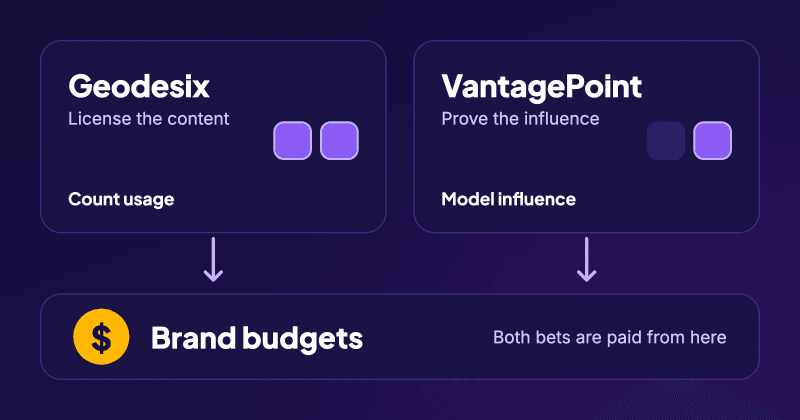
| Partnerize VantagePoint (opens in a new tab) | Brands Oct 2025; publishers Jan 2026 (opens in a new tab) | Built on Partnerize's June 2025 Konnecto acquisition (opens in a new tab). Ties AI-surfaced content to SKU-level sales, zero-click included, with a methodology certified by the Alliance for Audited Media. Citation data from Profound (opens in a new tab). The publisher version (opens in a new tab) is network-agnostic | A fractional commission Partnerize calls "non-duplicative by design": paid regardless of how the brand's existing attribution credits the sale. In the invite-only Lighthouse pilot (opens in a new tab), Partnerize itself pays those commissions (members include Adobe, HubSpot, Marriott, Away, Vox Media) |
| impact.com + Evertune (opens in a new tab) AI Search Visibility | Partnership Dec 2025; product slated for summer 2026 | An "AI Score" per category and the publisher domains LLMs cite most | Indirect: brands recruit cited publishers through impact.com's marketplace on normal terms |
| impact.com Geodesix (opens in a new tab) | Jan 28, 2026 | Launched as a marketplace licensing publisher reviews to AI developers. Its site (opens in a new tab) now also sells retailers review quotes for ads, product pages, checkout and chatbots | Pay per use: buyers "pay only when a citation is seen or acted on." Publishers connect through PHP or Python SDKs or a no-code WordPress plugin (opens in a new tab). Rates not disclosed |
| CJ AI Visibility & Optimization (opens in a new tab) | Jan 12, 2026 | Managed GEO campaigns across ChatGPT, Gemini, Perplexity, Claude and Copilot | "Flexible publisher compensation," unspecified |
| Awin AI Visibility (opens in a new tab) | Jun 30, 2026 | ScalePost citation data from publisher CDNs, plus Peec and Profound, tied to Awin conversions | Publishers share data "to get credit beyond clicks." No payout mechanism yet |
| Rakuten Advertising + Similarweb (opens in a new tab) | Mar 25, 2026 | LLM visibility for a select group of brands | Not disclosed |
| Tradedoubler Emna.ai (opens in a new tab) | May 27, 2026 | Share of voice and cited domains, run as campaigns through its network | Campaign spend through the network |
| PartnerStack Content Marketplace (opens in a new tab) (B2B SaaS) | Apr 30, 2026 | Placements on LLM-cited publishers, browsable by price | Flat fee, affiliate or hybrid, paid in-platform |
| Stacker (opens in a new tab) | Earned distribution; AI citation study Mar 2026 | Brand stories syndicated as editorial to 3,000+ news outlets, sold as a way to earn AI citations. Stacker claims a 239% median lift in brand citations (vendor study (opens in a new tab)). Annual recurring revenue grew from about $1M to about $10M between Jan 2024 and Mar 2026 (Axios (opens in a new tab)) | Stacker says outlets get the stories at no cost; no payment to publishers is disclosed |
A market this crowded needs a filter. The table above is only part of it. Add the intermediaries (Stacker for brand-funded syndication, ProRata's sponsored questions, agencies such as WPP Media, which says it works with publishers' commercial teams (opens in a new tab) on paid placements as part of AI search activation) and nearly every vendor now claims to turn AI visibility into revenue. Few publish rates, and several have no payout mechanism yet. Instead of judging each pitch on its own, run every one through the same five tests:
| Test | Ask | A good sign | A warning sign |
|---|---|---|---|
| Whose budget pays? | Which brand budget funds this: new spend, or a reshuffle of affiliate commissions? | A named budget and a funded pilot | "Brands are meant to fund it later" |
| Can finance verify it? | How is the influence measured (sample, logs or sales), and would a brand's finance team accept it? | Third-party certification, a holdout or incrementality test, results you can audit | A score only the vendor can produce |
| What do you give up? | Exclusivity, your data, content rights, a share of your own audience's revenue? | Non-exclusive, and you keep your data and your affiliate links | Exclusive terms, or your data feeding a product that competes with you |
| Is there a payout today? | Rates, payment dates, and who pays during a pilot? | Contracted rates and payments already made | "Flexible compensation" and no mechanism yet |
| Could you do this yourself? | Do you already have the audience, a brand studio and the brand relationships? | A third party that adds buyers or measurement you lack | A vendor that mostly repackages what your sales team could sell |
Build, buy or join. Publishers have three routes. Build: sell GEO inside your own branded-content deals, as the publishers in the deep dive below do. It uses relationships you already have, but it needs a brand studio and a way to measure results. Buy: pay for a measurement tool, so the evidence behind your sales conversations is better than a screenshot. Join: take part in a network program such as VantagePoint or Awin AI Visibility, which makes sense when your top advertisers already run their affiliate programs there. The pattern across the market is that the money sits closest to relationships that already exist. Be cautious about intermediaries that sell brands access to your audience without clear terms for you. Stacker, for example, has grown fast on brand budgets, and by its own description its outlets receive the stories at no cost.
Publishers are also selling GEO directly, inside branded-content deals. So far it's the most concrete brand money in the market, so it gets its own deep dive below.
Four ways brands are paying today:
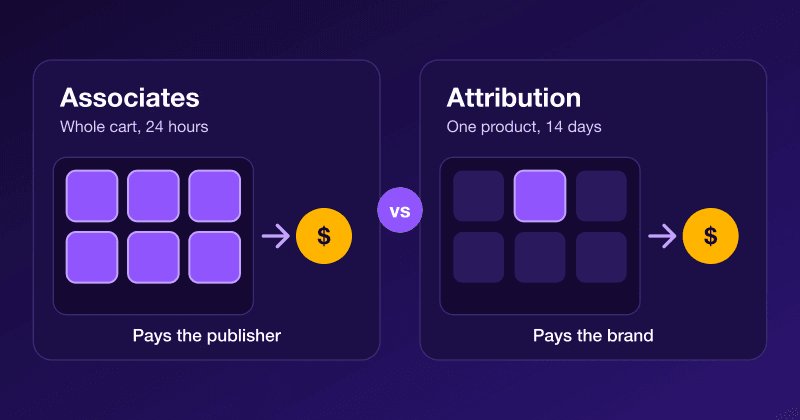
- Fractional influence commissions. Commission paid for influence, not only for the last click. Partnerize's own study claims publishers drive 3.84x more purchase influence than last-click shows (MarTech Cube (opens in a new tab); one month, 1,056 touchpoints). Partnerize says these payments sit on top of last-click credit rather than replacing it. Whether brands fund them with new budget is the open question.
- Flat fees on cited pages. Familiar tenancy deals, now priced with citation evidence.
- GEO branded content. Refresh the pages that get cited, then measure. No guarantees.
- Pay-per-use review licensing to retailers, as Geodesix now sells.
We found nobody paying citation bonuses, CPA uplifts for content that ranks in AI answers, or rates pegged to citation share.
Deep dive: publisher-sold GEO packages
The direct-sold side is where brand money is most concrete. Future says its AI visibility package has £2M sold and £10M booked for its fiscal year (H1 results, May 2026 (opens in a new tab)). Everyone selling GEO bundles it into branded content at a premium, guarantees nothing, and reports citations rather than sales.
Who's selling, and what's in the box
| Publisher | Offer | What's included | Measured with | Commercial signal |
|---|---|---|---|---|
| Future (opens in a new tab) | AI visibility package inside branded content, built on its in-house Optic tracker (beta Nov 2025) | Prompt testing; sponsored pieces written with summaries, bullets and FAQs, labelled "sponsored"; structured data; topics where Future titles are already cited | Optic | £2M sold, £10M booked; 30+ clients with renewals (Digiday, Oct 1 (opens in a new tab)). Samsung saw +28% AI citations from Future sources in 3 months (Digiday, Feb 19 (opens in a new tab), self-reported) |
| Time (opens in a new tab) | GEO offering (Mar 2026), plus Agent Ads (opens in a new tab) with Mobian since June | Audit across ChatGPT, Claude, Gemini and Perplexity on up to 100 prompts; branded text and video on Time and YouTube. Agent Ads show AI crawlers a slimmed copy of the page with one labelled sponsored FAQ block | TollBit, ScalePost, Mobian | Folded into branded content and priced "premium." Named buyers: Ally Bank, Project Management Institute, an automaker. Perplexity blocked the agent ads (opens in a new tab) as "deceptive" |
| BCN (opens in a new tab) (Burda, Funke, Klambt) | GEO Brand Impact (Jun 18, 2026) | Audit and competitor benchmark; strategy built on AI search intents; AI-optimised listicles, reviews and comparisons across about 300 titles reaching 63M users; ongoing tracking | Peec AI, Rankscale | "Premium end" of its branded-content range; sold as awareness, not performance; no guarantees (Digiday (opens in a new tab)) |
| Ziff Davis | GEO attached to branded-content deals | Not disclosed | Each client's own metrics | "A number of clients" (Digiday, Oct 1 (opens in a new tab)) |
Others are circling. Forbes sees a "clear opportunity" and measures with Profound; the Washington Post is working out how to package its citation data; Axios and the Daily Mail are testing (Digiday, Jul 16 (opens in a new tab)).
What a typical package contains
- An audit and competitor benchmark built on a prompt set.
- Topics where the publisher already holds citation share.
- New sponsored content in formats LLMs lift easily (FAQs, listicles, comparisons), or refreshes of existing pages.
- Structured data, and sometimes an agent-facing version of the page.
- Distribution across sister titles or YouTube.
- Tracking with a third-party tool or a proprietary one.
How it's priced and sold
It's sold inside branded content at the premium tier, by brand-studio and sales teams. No publisher has disclosed a price, minimum or contract length. Future's CEO calls the deals "bespoke" and "renewable because they need to remain visible" (Press Gazette (opens in a new tab)). That's the real model: a retainer for staying in the answer.
Nobody guarantees citations, and some publishers call vendors who do "snakeoil salesmen" (Digiday, Jul 16 (opens in a new tab)). Results come back as citations, share of voice and sentiment. None of the packages above reports sales.
A yardstick is arriving. The IAB's AI visibility guidelines (Aug 3, 2026) define four measures: presence, prominence, portrayal and persuasion (AdExchanger (opens in a new tab)). They treat anything under 50 queries as directional only and note that 20+ tools give materially different results. Only 16% of brands track AI visibility at all (PPC Land (opens in a new tab)). Expect brand buyers to start asking in these terms.
The risks to price in
- Google's site reputation abuse policy, revised Aug 28, 2026, targets third-party content published mainly to exploit a host's ranking signals (SEJ (opens in a new tab); Google spam policies (opens in a new tab)). Advertorials written for readers are fine. A pitch that openly sells your authority to the algorithm reads badly next to that policy, and the same piece syndicated across many titles invites scrutiny.
- Disclosure. The FTC wants unambiguous labels such as "Ad" or "Sponsored Advertising Content" (FTC guide (opens in a new tab)). The UK's ASA advises against "sponsored" alone (ASA (opens in a new tab)). Future and Time both label their pieces "sponsored."
- Whether labelled content gets cited is unproven. Muck Rack found paid content in 0.3% of 25M AI citations, against 84% for earned media (Muck Rack (opens in a new tab), vendor study). No independent test exists.
- Platforms can switch it off. Perplexity blocked Time's agent ads. And markdown versions of pages alone haven't been shown to lift citations (Digiday on a 1.6M-citation analysis (opens in a new tab)).
Where affiliate data adds to a GEO package
Branded-content GEO packages report citations, share of voice and sentiment, not sales. A commerce publisher already has the missing piece: affiliate links on the same pages the engines cite. Pair a GEO package with the brand's affiliate data, and one report can show citation share next to the commissioned sales those pages drive.
- Sell categories where you can prove citation share today, not coverage you hope to win.
- Keep sponsored and editorial apart. Label clearly, and put the sponsored piece beside your cited review, never inside it.
- Price it as a renewing retainer with measurement included, and never guarantee citations.
The playbook: instrument, prove, price
You can do three things this quarter: instrument what's free, build citation evidence brand by brand, and sell it through the channels brands already pay in. The cost is mostly analyst time. Nothing on this list needs an AI company to cooperate.
- Instrument what's free. Turn on Search Console's gen-AI report, Bing AI Performance and GA4's AI Assistant channel, plus Cloudflare AI Crawl Control or TollBit Analytics. Then join AI-referred sessions to affiliate clicks and commissions, page by page. Want to make this turnkey? Talk to Bullwhip to learn more about the capabilities of Beacon.
- Set crawler policy on purpose. Cloudflare now blocks training and agent crawlers by default on the ad-supported pages of new and free-plan sites (from Sep 15, 2026). Separate the bots that fetch pages for live answers, which can cite you, from training crawlers before you block anything.
- Build citation evidence by brand. For each top advertiser: which of your pages get cited for its category, in which engines, and what those pages earn per visit. Bing Citation Share and Peec or Ahrefs are the cheap way in. ScalePost is the route to log-based proof, and Hall shows which paragraph of yours the engine actually used.
- Sell through the pipes brands already use. Ask your Partnerize contact about VantagePoint and Lighthouse. Share data into Awin AI Visibility. Ask CJ and impact.com how their GEO programs pay publishers. VantagePoint for Publishers is network-agnostic, so it can measure your influence even where a brand runs its program elsewhere.
- Sell GEO packages with receipts. If you have a brand studio, package GEO the way Future and BCN do, then add what those packages don't report: the affiliate revenue your cited pages drive. Bullwhip's Beacon platform can help you activate this last piece with ease.
- Price the influence, not the click. Offer two structures: a flat fee to keep cited pages current, or a fractional commission on influenced sales. Before you accept an influence split, ask how incrementality is proven; a holdout test is the standard. The math is below.
- Monetize your own answers. If you have the traffic, test an on-site answer engine. Gist Answers from ProRata is free to embed, with a 50/50 split of the ad revenue.
- Apply, but don't plan around it. Take Google's AI Contribution pilot if invited, and fill in Microsoft's PCM interest form.
Don't build a budget on revenue share from AI-answer ads, pay-per-crawl income, or commissions through agentic checkout. None pays commerce publishers today.
The revenue math for an influence deal. Start from what the brand already pays, then size the slice your citations influence:
Your payout = Category sales × AI-influenced share × Commission rate × Your share of influence
An illustration with made-up inputs, not benchmarks: $2M of quarterly category sales × 10% AI-influenced × 6% commission is a $12,000 pool. A 25% share of influence earns you $3,000 a quarter for influence that last-click pays nothing for. That figure is the floor for a flat-fee ask.
Last-click pays whoever opened the door. Your content walked the shopper there. The click is shrinking, but the influence isn't, and influence is the part worth invoicing. Bring your own numbers to the table, and the conversation shifts from whether your influence is real to what it's worth.